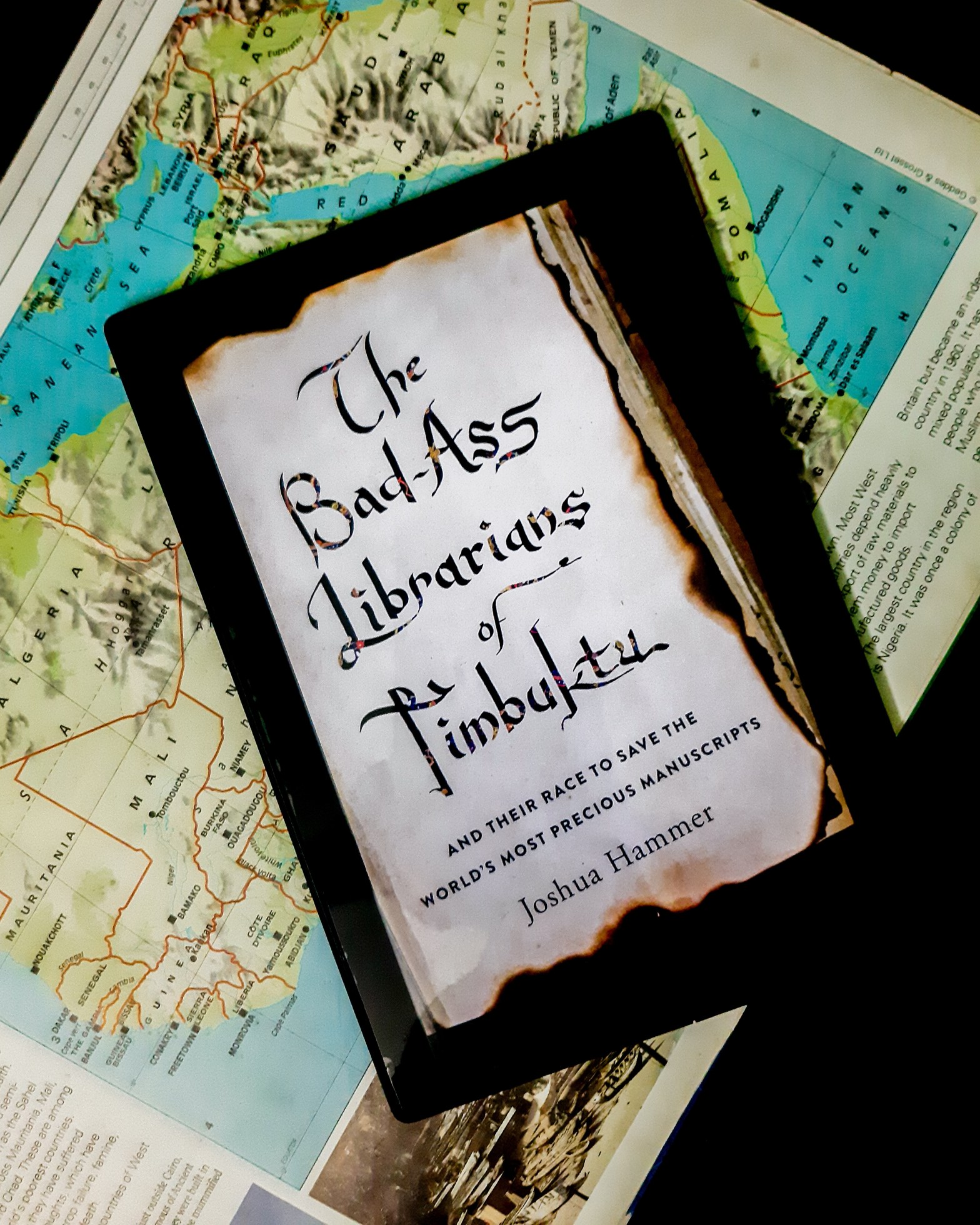
Who here knew that in the medieval period Mali, especially Timbuktu was a centre of trade and learning? There was also a bustling trade in manuscripts during the era. Numerous such manuscripts were collected by households and were passed down in families. They conserved these as best as they could during all the subsequent turbulent periods; like the French colonial rule and Jihadi invasions in the 1800s. It was in the modern era that the a man named Abdul Khader Haidara took a major initiative to bring together all of them for the Ahmed Baba Institute in Timbuktu. He also held a private collection of around 22,000 items at the Mamma Haidara Commemorative Library. Several other private libraries were also built to help preserve and digitise these invaluable works. There’s believed to be a total of about 700,000 such manuscripts.
The main part of the book deals with the period succeeding the Arab Spring, which even managed have an affect on Mali all the way across the Sahara. It influenced the Tuaregs (an ethnic group persecuted in Mali) to come together as the National Movement for the Liberation of Azawad(MNLA). As the movement progressed and Timbuktu was captured, Islamic groups like the AQIM and Ansar Dine, who had helped in the movement took control and implemented Sharia rule in the area. This put the manuscripts in danger, and fortunately Abdul Haidara and several persistent men were able to pull most of those out. Before with the Jihadi’s defeat, their attention turned to the manuscripts and a few hundred were burned out of spite.
Mali is still in a lot of turmoil with the recent military coup in 2020.
The book doesn’t limit itself to just the story of the manuscripts and gives an well-rounded picture of everything I wanted to know about Mali. I’d really recommend this book, if you like history.
Mali: Bad Ass Librarians of Timbuktu
 booksandtheopenroad.travel.blog